Behind the Counter: What Pharmacy First’s Consultation Data Can and Cannot Tell Us in 2026
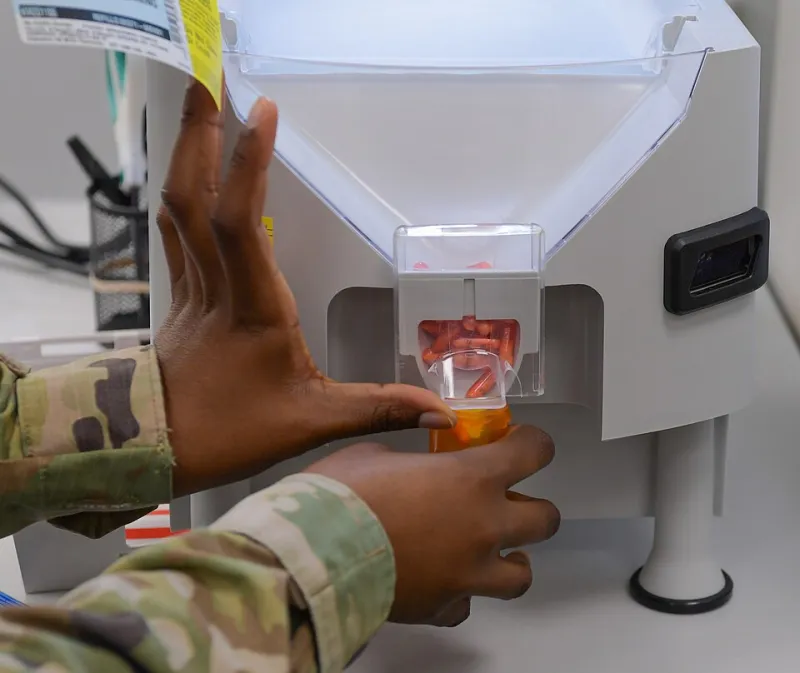
Photo: U.S. Air Force photo by Airman Trevor Calvert, Public domain, via Wikimedia Commons
Pharmacy First is often described as a way to move minor illness away from general practice and into community pharmacy. For readers of health data, it is more useful to begin with a narrower question: what does a Pharmacy First consultation actually leave behind in the record? The answer matters because the service is now a visible stream of NHS activity, and visible activity is easily mistaken for a complete account of demand.
A consultation is an administrative event
Pharmacy First began in England in 2024, building on earlier pharmacy consultation services. In 2026 it remains a route through which participating community pharmacies assess and, where appropriate, supply medicines for specified clinical pathways, as well as supplying urgent repeat medicines in defined circumstances. Each completed consultation can generate a record used for payment and monitoring.
That record is not a transcript of everything that happened at the counter. It is an administrative event. A patient who asks for advice and leaves without a recorded consultation may not appear. A conversation that begins but does not meet the service criteria may be recorded differently, or not at all. A pharmacy may be open but not participating in the service, or participating but unable to offer an appointment at the time the patient calls. The published count therefore measures recorded, claimable activity. It does not measure unmet need, informal advice or the number of people who decided not to seek help.
Categories are pathways, not diagnoses
The data usually distinguish consultations by clinical pathway or condition category. These categories are useful for describing the shape of the service, but they are not the same as diagnosis codes in a hospital record. A category indicates which pathway was used and which criteria were applied. It does not necessarily capture severity, comorbidity or the final clinical judgement.
This distinction becomes important when figures are presented as a map of illness. A rise in a particular pathway may reflect genuine changes in illness, but it may also reflect greater pharmacy participation, improved recording, public awareness or a local change in GP access. Without denominators, a category count is a volume, not a rate. Without context, it is a description of activity, not an explanation of need.
Supply, referral and the meaning of an outcome
Pharmacy First records include outcomes such as whether a medicine was supplied, whether the patient was referred elsewhere, or whether the consultation ended with advice. These fields are often read too quickly. A referral does not prove that the patient attended the referral destination, nor that the referral was clinically necessary in retrospect. It may reflect appropriate caution, a pathway exclusion, or a patient’s own preference. Equally, a consultation without a supply is not a failure. It may be the correct outcome when self-care advice is sufficient.
The more useful question is not whether referrals are high or low in isolation, but whether referral patterns are consistent with local service capacity and with the clinical pathways. That requires linking aggregate data to local context, not treating a single outcome field as a verdict on quality.
Workload needs a denominator
Community pharmacy workload is a recurring concern in NHS planning. Pharmacy First consultation counts can contribute to that discussion, but only if they are set against the right denominators: the number of pharmacies offering the service, their opening hours, the size and age structure of the local population, and the availability of alternative services. A rise in consultations may indicate greater access. It may also indicate that more pharmacies have joined the service or that recording has improved.
Access is especially difficult to infer from national totals. Rural areas, areas with high deprivation and areas experiencing pharmacy closures may show different patterns from urban centres. A high count in one place does not automatically mean easy access; it may mean that demand is concentrated among a small number of participating pharmacies. A low count does not automatically mean low need.
The substitution question cannot be settled by subtraction
It is tempting to subtract Pharmacy First consultations from GP appointment demand and call the difference diverted care. That arithmetic is not reliable. The two datasets describe different case mixes, different recording practices and different patient behaviour. Some patients may consult both a pharmacy and a GP for the same episode. Others may use Pharmacy First because it is newly available, not because they would otherwise have booked a GP appointment. GP appointment data have their own known limitations around coding and activity definitions.
Answering the substitution question properly requires linked data and local evaluation, both of which raise privacy and governance issues. In their absence, the safest reading is that Pharmacy First adds a new point of contact. Whether it reduces pressure elsewhere is an empirical question, not an assumption built into the count.
Reading the ledger responsibly in 2026
Pharmacy First data are most valuable as operational signals. They can show where recorded consultations are concentrated, which pathways dominate, how often patients are referred onward, and how activity changes over time. They can help commissioners ask whether the service is reaching the populations it was designed to serve. They should not be used as a league table of GP access, nor as proof that minor illness has been solved.
The disciplined approach is to read the ledger for what it is: a record of completed, claimable consultations in a new service. It is a useful digitised trace of NHS activity, but it is not the whole patient journey. As with any administrative health dataset, the first question should be what the number counts, and the second should be what it leaves out.